Can You Use Drano in a Septic System? (Safe Unclogging Alternatives)

The drain is clogged. You have a bottle of Drano under the sink. The question feels simple.
It is not.
Using Drano in a home with a septic system does not just unclog the drain — it kills the biological ecosystem your tank depends on to function. A single full dose of a sodium hydroxide drain cleaner can eliminate the majority of your septic tank's bacterial population. Without those bacteria, your tank stops processing waste. Sludge accumulates at an accelerated rate. Solid waste begins escaping into your drain field within weeks.
This guide explains exactly what Drano does to septic bacteria, why it is particularly dangerous for tanks, and what to use instead when a drain blocks.
Consumer Alert 2026
A single use of a sodium hydroxide or bleach-based drain cleaner in a home with a septic system can reduce the tank's beneficial bacterial population by up to 90%. Without bacterial recovery treatment, sludge accumulation rates double within 30 days — pushing systems toward drain field failure months ahead of schedule.
— Residential Wastewater Systems Report, 2026
What Drano Actually Does to a Septic Tank
Drano and similar chemical drain cleaners work through one of two mechanisms:
Sodium hydroxide (lye/caustic soda): Generates intense heat — up to 250°F (121°C) — through an exothermic chemical reaction. This heat and caustic alkalinity physically dissolves organic blockages like hair, grease, and soap scum.
Sodium hypochlorite (bleach-based variants): Chemically oxidizes the organic material forming the clog, breaking molecular bonds in fats, proteins, and cellulose.
Both mechanisms are brutally effective at dissolving organic matter — which is precisely the problem. Your septic tank is full of organic matter being processed by living bacteria. When caustic chemicals reach the tank:
- The extreme pH (sodium hydroxide raises water pH to 12–14) kills acid-sensitive aerobic and anaerobic bacteria indiscriminately.
- The heat generated in and near the drain pipe propagates into the tank, further destabilizing bacterial colonies.
- Any surviving bacteria are too few in number to maintain adequate digestion rates for normal household waste loads.
Why the "One Small Bottle Won't Hurt" Logic Fails
A 32-ounce bottle of Drano is diluted by hundreds of gallons of water before it reaches the tank — and the argument usually ends there.
What this logic ignores: the bacteria in your septic tank are not distributed evenly throughout that volume of water. The active bacterial colonies are concentrated at the sludge-water interface at the bottom of the tank, where they are digesting solid waste. This is precisely where the denser, settled chemical residue also accumulates.
The bacteria that matter most to your tank's function are concentrated at the exact location where chemical drain cleaners have their highest residual concentration.
"The dilution argument significantly underestimates the impact of chemical drain cleaners on septic systems. Caustic residue settles to the tank bottom where active bacterial colonies are densest, producing a localized kill zone that can take 6 to 10 weeks for natural bacterial populations to recolonize — assuming no further chemical exposure during that window."
What to Use Instead: Safe Septic Drain Unclogging Alternatives
1. Boiling Water (For Grease Clogs)
For kitchen sink clogs caused by congealed grease, boiling water poured slowly down the drain in three stages (with 30 seconds between each) melts the grease without any chemical residue. Effective for fresh grease clogs; ineffective for hair or soap accumulation.
2. Baking Soda + Vinegar (For Mild Clogs)
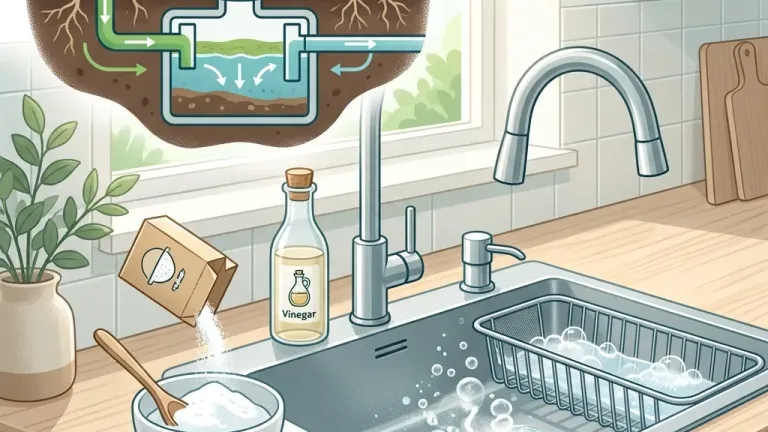
Pour half a cup of baking soda followed by half a cup of white vinegar into the drain. Cover the opening immediately to direct the reaction downward. Let it fizz for 30 minutes, then flush with hot water. The physical pressure of the CO₂ reaction can dislodge minor blockages. Safe for septic tanks and completely non-toxic to bacteria.
3. A Drain Snake or Auger (For Hair and Debris Clogs)
A manual drain auger reaches 15–25 feet into a pipe and physically breaks up or retrieves the blockage. No chemicals, no bacterial damage. This is the most reliable fix for hair clogs in shower drains and is available at any hardware store for $20–$40.
4. Enzyme-Based Drain Cleaners
Unlike Drano, enzyme-based drain maintenance products use concentrated lipases, proteases, and amylases to biologically dissolve organic blockages. They are slower (typically 6–8 hours versus the instant action of caustic chemicals), but they are completely safe for septic bacteria and will actually contribute positively to the tank's biological ecosystem.
Look for products specifically labeled "enzyme drain cleaner" or "biological drain opener" — not products labeled "enzymatic-enhanced" that still contain caustic agents as the primary active ingredient.
5. Septic-Safe Biological Treatments (For Recurring Slow Drains)
If your drains are chronically slow — not dramatically clogged, but consistently sluggish — the problem is likely downstream of the individual drain pipe. Accumulated sludge in the septic tank can raise the liquid level enough to slow drainage from the house's plumbing.
In these cases, addressing the sludge accumulation directly resolves the drain slowness without any drain work at all. The best septic tank sludge dissolvers use aerobic bacteria and oxygen-release technology to reduce the sludge layer month over month — eliminating the backpressure that was causing your drains to run slow.
What to Do If You Already Used Drano
If you used a chemical drain cleaner before knowing about its impact on septic tanks, the damage is not necessarily permanent — but you need to act quickly.
Step 1 — Do not use any more chemical cleaners. Even products marketed as "safe for septic" that still contain sodium hypochlorite will compound the bacterial kill. Switch entirely to septic-safe products immediately.
Step 2 — Apply a biological shock treatment. Flush 2–3 high-CFU oxygen-release tablets down the toilet closest to the tank. The oxygen they release creates conditions where new aerobic bacterial colonies can establish quickly, accelerating the recolonization process.
Step 3 — Eliminate antibacterial products for 4–6 weeks. Antibacterial soaps, bleach cleaners, and disinfectants will eliminate any bacteria attempting to recolonize the tank during its recovery window.
Step 4 — Reduce water usage for 48–72 hours. Heavy water use immediately after a chemical drain cleaner event flushes bacteria through the system before they can reestablish. Lighter usage gives recovering colonies a better chance to stabilize.
Frequently Asked Questions
Is Drano Max Gel safe for septic systems?
No. Despite some marketing language suggesting it is "septic-safe," Drano Max Gel contains sodium hydroxide as its primary active ingredient. The caustic chemistry that makes it effective at dissolving clogs is the same chemistry that kills septic bacteria. No amount of brand marketing changes the underlying biochemistry.
What about Green Gobbler or other "natural" drain cleaners?
Products that are genuinely enzyme-based (containing only biological enzymes and no caustic alkaline agents) are safe for septic systems. Read the active ingredients, not the label. If you see sodium hydroxide, potassium hydroxide, sulfuric acid, or sodium hypochlorite in the active ingredients, the product is harmful to septic bacteria regardless of its branding.
Can I use a chemical drain cleaner in an emergency if I'll pump the tank soon anyway?
Pumping removes bacteria along with sludge. Using a chemical drain cleaner before pumping means you are starting a freshly pumped tank with a depleted bacterial population — the worst possible starting position. The tank will struggle to establish bacterial populations in the weeks after pumping, accelerating sludge re-accumulation.
How long until my septic tank bacteria recover after Drano?
Without active biological treatment, natural bacterial recolonization from the surviving population takes 6–10 weeks — assuming no further chemical exposure. With a high-CFU biological shock treatment, meaningful recovery typically occurs within 3–4 weeks.
Are there any situations where chemical drain cleaners are acceptable with a septic system?
If the clog is entirely within the house's internal plumbing — in a fixture trap or a horizontal drain line that does not connect to the septic tank — a very small amount of a caustic cleaner used once, followed by significant flushing, may have a negligible impact. However, this requires certainty about the plumbing geometry, which most homeowners do not have. The safer default is always a mechanical solution (drain snake) or an enzyme-based product.
After Our Independent Analysis
For homeowners with septic systems, the default reaction to a clogged drain — reaching for a chemical cleaner — is one of the most damaging things you can do to a system you rely on every day. Biological enzyme treatments and mechanical augers solve the immediate blockage problem without destroying the bacterial ecosystem your tank needs to function. For chronically slow drains that signal deeper sludge accumulation, oxygen-release biological treatments address the actual source of the problem rather than masking it.
Transparency: By clicking, you will be redirected to the manufacturer's official site. This is an independent editorial review that contains affiliate links.
Free Homeowner Tools
- Septic Treatment Finder — Not sure which type of treatment is right for your symptoms? Answer 3 questions and get a targeted recommendation.
- Septic Tank Sludge Level Finder — Assess your tank's sludge risk and find the right biological protocol.
- Drain Field Risk Diagnostic — If your drains are persistently slow, check whether your drain field is contributing to the system-wide backpressure.