
Septic Tank Smells Worse After Rain? (Science & Fix)
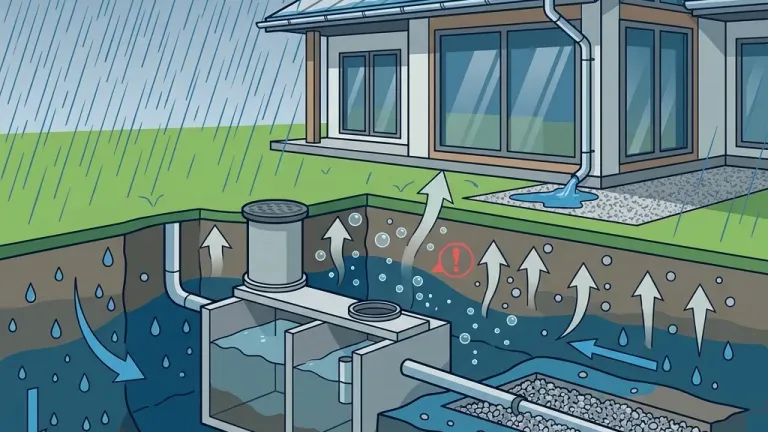
You notice it every time. The sky opens up, the rain comes down, and within hours your yard smells like a sewer. The smell fades when the weather clears, and you start wondering if you just imagined it.
You did not imagine it.
A septic tank that smells worse after rain is responding to measurable physical and biological changes that occur whenever water saturates the ground around your system. Understanding the four mechanisms behind this pattern is the first step toward eliminating it — because this particular odor spike is one of the most reliably fixable problems in residential wastewater management.
The 4 Reasons Your Septic Tank Smells Worse After Rain
1. Barometric Pressure Drop Traps Gases Near the Ground
The most immediate cause is atmospheric physics, not plumbing.
Before and during rainfall, barometric pressure drops. Heavy gases — including hydrogen sulfide (H₂S), the compound responsible for the rotten egg smell — are normally lighter than the air pressure and escape upward through your home’s roof vents. When atmospheric pressure drops, this upward escape pathway is disrupted.
Instead of venting vertically, the gas spreads horizontally near ground level. This is why the smell seems to appear suddenly from everywhere — tank covers, the lawn above lateral lines, even areas of the yard you never noticed before. The septic system hasn’t gotten worse. The gas that was always being produced is simply no longer escaping upward.
What this tells you: If the only time you smell septic odor is during pressure drops and rain, and the smell disappears completely within 24 hours of the weather clearing, your system may be biologically healthy but have a venting insufficiency. A licensed plumber can inspect your roof vent stack for blockages.
However: If the smell persists for more than 48 hours after rain, or has been getting stronger over successive rainstorms, you are dealing with one or more of the following causes — which indicate a biological problem inside the tank.
2. Saturated Soil Blocks the Drain Field’s Natural Venting
Your drain field does more than absorb liquid effluent. The soil acts as a passive biological filter and a secondary gas-venting system. Under normal conditions, gases produced in the lateral lines escape slowly through unsaturated soil pores.
When rain saturates the ground:
- Soil pores fill with water, eliminating the air pathway through which gases normally escape.
- Gas that would have vented through the ground is forced back toward the tank and up through any available opening — tank seams, access covers, or the toilet’s water trap if plumbing seals are degraded.
- The drain field is also temporarily unable to accept new effluent, building hydraulic pressure in the entire system that pushes gas toward the surface.
“Seasonal odor complaints that correlate directly with rainfall events are almost always a combination of two factors: ground saturation blocking normal venting pathways, and an underlying biological imbalance in the tank that becomes impossible to mask when the system is hydraulically stressed.”
What this tells you: If you notice your indoor drains also slow down after heavy rain, the ground around your drain field is at or above its hydraulic capacity. This is a warning sign of early-stage drain field stress — not necessarily failure, but worth monitoring closely. The leach field treatment guide covers the non-invasive approach to restoring drain field capacity before it reaches the excavation threshold.
3. Rainwater Infiltrates the Tank Through Cracks or Poor Seals
Older concrete septic tanks develop hairline cracks in the walls, lid, or inlet/outlet baffles over time. During heavy rain, groundwater can infiltrate the tank through these openings — a phenomenon called inflow and infiltration (I&I).
When rainwater floods into the tank:
- Tank volume spikes suddenly. The hydraulic shock forces liquid through the system faster than bacteria can process it, pushing partially digested solids into the drain field.
- Cold water disrupts bacterial activity. Bacterial digestion slows dramatically in cold water, reducing the tank’s ability to process waste during the exact period it is receiving the most stress.
- Gas is physically displaced. The sudden volume increase pushes gas out of every available opening — seams, pipe penetrations, and soil vents simultaneously.
This mechanism produces the most intense and sudden post-rain odor spikes. If you notice the smell hits hardest in the first 2–4 hours of a heavy rain event rather than building gradually, tank infiltration is the likely culprit.
What to do: This requires a physical inspection of the tank’s structural integrity. A licensed inspector can perform a dye test or camera inspection to identify infiltration points. Concrete sealing compounds can address minor cracks; severe structural damage requires tank replacement or lining.
4. The Underlying Biology Is Already Failing — Rain Just Exposes It
This is the cause most homeowners don’t want to hear, but it is the most important one.
A properly balanced septic system — one with a healthy aerobic and anaerobic bacterial ecosystem, sufficient bacterial density, and appropriate sludge levels — produces minimal H₂S gas under any weather conditions. The gas it does produce is safely processed and vented.
A biologically compromised tank, however, is producing hydrogen sulfide continuously. Under normal conditions, enough of it escapes through the roof vents and soil venting that the ground-level concentration stays below the threshold you can smell. Rain changes the escape dynamics — and suddenly the gas that was always being produced at high levels has nowhere to go.
This is why the rain doesn’t cause the smell. It reveals it.
If the rain-triggered smell has been getting more intense over the past 6–12 months, the underlying biological collapse is deepening. Each rain event will smell worse than the last until the root cause — the imbalance between aerobic and anaerobic bacteria — is corrected.
How to Fix Rain-Related Septic Odors Permanently
Rain-triggered odor spikes rooted in biological imbalance respond reliably to restoring aerobic bacterial dominance through oxygen delivery.
Why this works for rain-specific odors in particular: When aerobic bacteria dominate the tank ecosystem, H₂S production drops to near-zero regardless of barometric pressure or soil saturation conditions. There is no gas to trap at ground level. Rain no longer triggers the smell because the smell is no longer being generated.
The protocol:
Week 1 — Shock treatment. Flush 2–3 oxygen-release effervescent tablets on alternating days. These tablets sink to the tank bottom, release free oxygen into the wastewater column, and neutralize existing hydrogen sulfide molecules on contact while inoculating the tank with aerobic bacteria.
Weeks 2–4 — Biological stabilization. Flush one tablet weekly. Eliminate antibacterial soaps, bleach, and chemical drain cleaners from your household routine entirely during this phase. A single bleach use can reset the aerobic colony establishment by several days.
Month 2+ — Maintenance. One tablet monthly maintains the aerobic ecosystem. You should notice that the next significant rain event produces little to no odor at your property line.
See the Oxygen-Release Treatment That Stops Rain-Triggered Septic Odors
Targets the biological root cause — not just the symptom.
Read the Full GuideWhat If the Smell Persists Despite Treatment?
If a full 8-week biological protocol does not meaningfully improve the post-rain odor spike, one of the physical causes is likely at play:
- Vent stack blockage — Bird nests, debris, or root intrusion can block roof vent stacks. A plumber can inspect and clear these for $100–$300.
- Tank seal or lid degradation — Cracked concrete lids or degraded rubber seals allow groundwater in and gas out. New tank lids typically cost $200–$600 installed.
- Drain field saturation — If your field no longer absorbs at an adequate rate, every rain event creates hydraulic backup. See the leach field treatment guide to assess whether biological intervention can restore absorption before excavation becomes necessary.
Frequently Asked Questions
Is the post-rain septic smell dangerous?
At concentrations found in outdoor residential environments, hydrogen sulfide is unpleasant but not acutely dangerous. However, if the smell enters the home’s interior, the source must be identified and sealed immediately — indoor concentrations can reach levels that cause headaches and respiratory irritation.
Does heavy rain dilute the tank and reduce odor?
In a biologically healthy tank, yes — dilution can temporarily reduce gas concentration. In a biologically compromised tank, the opposite is true: rainwater inflow displaces gas and accelerates its surface escape.
Will pumping the tank stop the post-rain smell?
Pumping provides 2–4 weeks of odor relief by removing gas-producing organic matter temporarily. Without biological restoration, anaerobic bacteria repopulate and resume H₂S production within weeks of normal water usage.
My neighbor’s yard doesn’t smell after rain. Why does mine?
The most common explanation is biological: their tank maintains higher aerobic bacterial activity, suppressing H₂S production regardless of weather. The second most common cause is venting: their roof vent stacks are clear and appropriately sized for their household flow.
For the full protocol on eliminating septic odors at their biological source, read the complete septic tank odor eliminator guide.
Best Septic Tank Odor Eliminators
Rain-triggered odors are a biological distress signal - not just a weather inconvenience. For a complete guide to diagnosing and eliminating the hydrogen sulfide producing the smell, see our review.
Read the Full GuideFree Homeowner Tools
- Septic Odor Source Finder — Identify whether your septic smell is coming from inside, outside, the tank, or the drain field.
- Drain Field Risk Diagnostic — Assess whether rain-driven saturation has pushed your field into early-stage failure.
- Septic Treatment Finder — Get a treatment recommendation matched to your specific symptoms.