
How Cooking Grease Ruins Septic Systems (And What to Do)
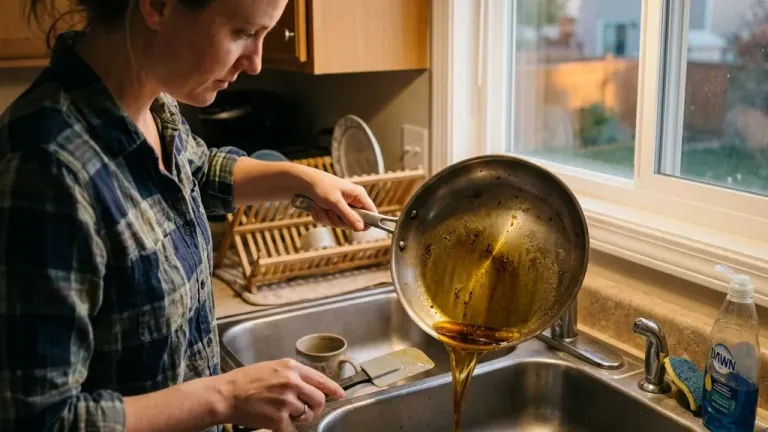
The FOG Problem: What the Plumbing Industry Calls It
In wastewater management, fats, oils, and grease from cooking and food preparation are collectively referred to as FOG — and they are the subject of significant regulatory attention at the municipal level because of the damage they cause to both public sewer lines and private septic systems.
At the municipal scale, FOG blockages create what engineers call “fatbergs” — massive, concrete-like accumulations of solidified grease, food particles, and other materials that can completely obstruct sewer mains. The private residential equivalent occurs inside septic tanks and drain field pipes, on a smaller scale but with equally damaging consequences for individual homeowners.
What Happens When Grease Enters Your Septic Tank
When liquid grease poured down a kitchen drain reaches the septic tank, it initially behaves as a liquid. But several things happen over time that make it progressively more damaging:
Solidification: Most cooking fats — including lard, butter, shortening, and the grease from cooked meat — are solid or semi-solid at temperatures below 70°F (21°C). Underground, your septic tank maintains temperatures lower than a heated kitchen. Liquid grease that enters the warm pipe cools rapidly as it moves toward the tank, and begins to solidify before it arrives.
Scum layer accumulation: Grease that reaches the tank in liquid form rises to the surface of the liquid zone and joins the scum layer. Unlike organic solids that can be biologically digested, anaerobic bacteria — the dominant population in most residential septic tanks — cannot efficiently break down fats and oils. Grease accumulates faster than it is consumed.
Baffle coating: As grease accumulates and the scum layer thickens, it eventually coats the outlet baffle with a layer of fat. This narrows the effective outlet opening, increases the risk of solids bypassing the baffle, and eventually causes the baffle to fail structurally if grease hardens around fittings.
The Drain Field Consequence
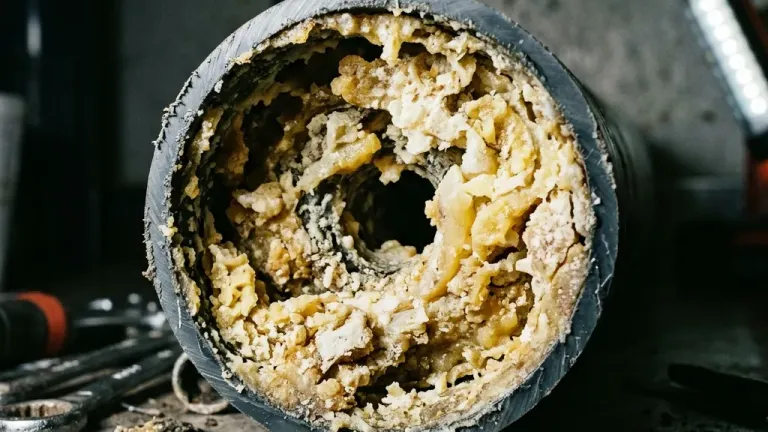
The most serious long-term consequence of chronic grease loading is not what happens inside the tank — it’s what happens in the drain field.
Grease that bypasses the outlet baffle enters the effluent stream and travels to the drain field distribution system. Inside the perforated distribution pipes, it deposits along the pipe walls and around the perforations that are supposed to allow effluent to flow into the gravel bed. Over time, those perforations become partially or completely blocked by hardened grease — preventing the even distribution of effluent across the field and creating hydraulically saturated zones.
Once grease penetrates the gravel layer itself and reaches the soil-gravel interface, it begins to coat soil pores — creating a water-repellent layer that blocks the natural percolation process. This is the mechanism that transforms a grease problem into a drain field failure. Read about when grease reaches the leach field and why FOG is the leading cause of drain field failure.
Common Sources Homeowners Underestimate
Most homeowners are aware that they shouldn’t pour pan drippings directly down the drain. The less obvious FOG sources include:
- Dish soap and hot water — While this temporarily liquefies grease in the drain line, the grease re-solidifies as water cools downstream.
- Garbage disposal use — Grinding food waste rich in fats (meat scraps, cheese, sauces) and flushing it through hot water does not prevent grease from accumulating — it simply moves it further into the system.
- Dairy products — Milk, cream, and butter contain significant fat content that contributes to scum layer growth.
- Salad dressings and cooking oils — Even plant-based oils (olive oil, vegetable oil) contribute to the scum layer and are poorly digested by anaerobic bacteria.
What the Biology Can — and Cannot — Do
The key distinction in understanding grease impact on septic systems is the difference between aerobic and anaerobic digestion of lipids (fats):
- Anaerobic bacteria (the default population of a sealed residential septic tank) have very limited capacity to break down long-chain fatty acids and triglycerides. They produce incomplete degradation products that remain as persistent deposits.
- Aerobic bacteria are significantly more effective at digesting fats and oils through a process called beta-oxidation. However, they require dissolved oxygen to function — which is naturally absent in a sealed tank.
Homeowners who supplement their tank’s biological population with oxygen-releasing treatments support a more aerobic environment, which can partially offset FOG accumulation. You can review treatments that specifically target grease breakdown for this purpose. However, biological treatment is not a substitute for reducing FOG input at the source — it works in conjunction with behavioral changes, not instead of them.
Practical FOG Reduction Strategies
- Wipe pans before washing — Use paper towels to remove excess grease from pans and dishes before rinsing with water. Dispose of the paper towel in the trash. Learn about paper product degradation in our review of toilet paper for septic systems.
- Collect and dispose of cooking oil separately — Cool used oil in a lidded container and dispose of it with household waste or at a local FOG recycling program.
- Run cold water when using the garbage disposal — Counterintuitively, cold water keeps fats solid and helps them move through pipes as particles rather than coating pipe walls as a liquid film.
- Inspect under-sink drain traps periodically — Grease accumulates first in the P-trap directly under the sink. Visible grease here is an early indicator of how much is reaching the tank.
Consistent FOG reduction is one of the most impactful changes a homeowner can make to extend the functional life of both their septic tank’s biological ecosystem and their drain field’s soil absorption capacity. Learn the full maintenance strategy for households that cook to fully protect your investment.