
Septic Drain Field Failure: 5 Warning Signs to Watch For

What Is a Drain Field, and Why Does It Fail?
If you own a home on a private septic system, your property has two distinct underground systems working together: the septic tank, which handles the initial separation of solids and liquids, and the drain field (also called the leach field or soil absorption system), which receives the liquid effluent from the tank and filters it through layers of gravel and soil before it re-enters the groundwater table.
When the drain field works correctly, it operates silently and invisibly beneath your lawn for decades. When it begins to fail, it typically does so gradually — over months or even years — sending subtle signals that most homeowners dismiss as unrelated yard or plumbing issues. If you suspect an issue, you can test your soil’s current absorption rate.
Understanding those signals early is the difference between a manageable biological leach field treatment before excavation and a $10,000–$20,000 drain field replacement or excavation project. Implementing proper maintenance prevents this kind of financial disaster.
Warning Sign #1: Slow Drains Across Multiple Fixtures
If a single drain is slow, the problem is almost certainly a localized blockage in a specific pipe — a hairball, grease deposit, or object lodged in the line. This is a straightforward plumbing issue.
However, if multiple drains in your home — kitchen sink, bathroom sink, shower, and toilet — are all draining slowly at the same time, the problem is almost certainly downstream from your plumbing. The most common culprit in rural and suburban properties on private septic is a saturated or clogged drain field that can no longer accept liquid effluent from the tank.
What to do: Do not attempt to address this with chemical drain cleaners. Strong chemical solutions (bleach, lye-based products) that reach the septic tank will kill the beneficial bacterial colonies needed for biological breakdown, worsening the underlying problem. Instead, reduce household water use immediately and consult a certified septic inspector.
Warning Sign #2: Wet or Spongy Ground Over the Drain Field
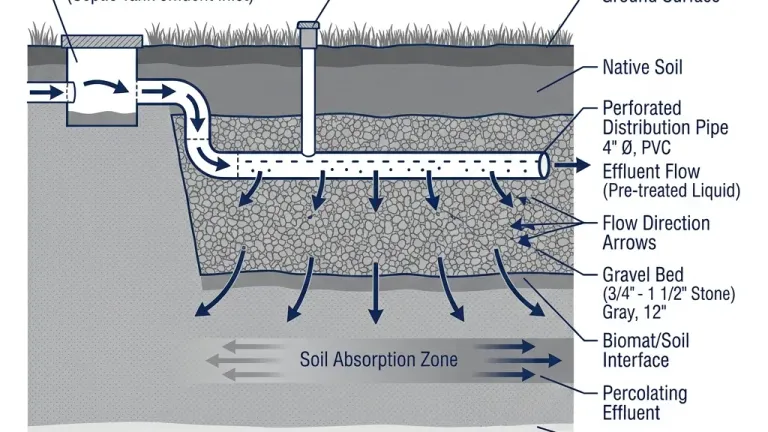
One of the most visually alarming — and diagnostically clear — warning signs is wet, spongy, or perpetually damp ground directly above the area where your drain field pipes run. This indicates that liquid effluent is surfacing because the soil can no longer absorb it fast enough.
This occurs for one of two reasons:
- Hydraulic overload: Too much water is entering the system in a short period (large families, excessive laundry loads, or leaking fixtures).
- Biomat formation: A dense layer of anaerobic bacteria and organic solids has formed at the soil-pipe interface, creating an impermeable barrier that prevents effluent from percolating downward.
Biomat formation is the more serious and more common long-term failure mechanism. It develops progressively as undigested organic solids from the tank accumulate at the drain field inlet. Understanding the role of bacteria in biomat buildup is the first step, and you must also consider how grease accelerates biomat formation. Addressing the bacterial health of the septic tank — through oxygenation and aerobic bacteria introduction — is the primary strategy for halting or reversing early-stage biomat formation.
Warning Sign #3: Unusually Green or Lush Grass Patches
Counterintuitively, a zone of unusually dark green, fast-growing grass above your drain field is not a good sign. It indicates that the leach field is receiving more nitrogen-rich liquid than the soil can properly absorb, and that effluent is surfacing close enough to the root zone to act as a fertilizer.
While it may look healthy from a distance, this pattern indicates hydraulic saturation of the upper soil layers. During heavy rain periods, this can escalate rapidly from green grass to standing water to fully surfaced sewage.
Warning Sign #4: Gurgling Sounds from Toilets or Drains
Gurgling or bubbling sounds emanating from a toilet after flushing, or from a drain after running water, are caused by air displacement in the plumbing system. Pay special attention if you notice laundry water backing up in your septic system or other early septic drain field clogged signs. In a healthy septic system, air moves freely through the vent stack. When the drain field is saturated and is pushing back against normal flow, air pressure in the drain lines is disrupted — causing the audible gurgling effect.
This warning sign is frequently misattributed to standard plumbing vent issues. If the gurgling appears across multiple fixtures simultaneously and is accompanied by any other signs on this list, the septic system should be evaluated before the situation escalates.
Warning Sign #5: Sewage Odors in the Yard or Around Floor Drains
The final, unmistakable signal is odor: the rotten-egg hydrogen sulfide smell associated with raw or improperly treated sewage. If this odor is detectable outdoors near the drain field area, or indoors near basement floor drains, the system has almost certainly reached a critical saturation point.
At this stage, the risk of groundwater contamination and regulatory intervention is real. In many U.S. counties, surfacing sewage requires mandatory reporting to local health departments and may require immediate corrective action.
The Biological Root Cause: Why This Keeps Happening
All five warning signs share a common upstream cause: insufficient biological breakdown of organic solids in the septic tank. When the tank’s bacterial population is unable to fully digest fats, oils, and solid waste, partially digested effluent exits the tank and carries those solids into the drain field, where they accumulate over time.
The standard remedy — mechanical pumping — removes solids temporarily but does nothing to address the biological inefficiency that caused the buildup. Homeowners who pump on a reactive schedule typically find themselves facing the same problem, and escalating costs, within 12–18 months.
Residential infrastructure specialists increasingly recommend integrating biological oxygen-release treatments alongside (and between) mechanical pumping services as the most cost-effective long-term management strategy for suburban septic systems. If you’re already seeing signs of failure, learning how to treat a clogged leach field and researching treatments that help restore drain field health becomes urgent.
Key Takeaways for Homeowners
- Multiple slow drains, wet ground, unusually green grass, gurgling sounds, and sewage odors are all interconnected drain field warning signs.
- The root cause in most cases is inadequate biological breakdown in the septic tank, not just hydraulic overload.
- Early detection allows for biological intervention; late detection may require drain field replacement at significant cost.
- Reducing water input and improving tank biology are the first two steps before any mechanical intervention.
Free Homeowner Tools
- Drain Field Risk Diagnostic — Take our 2-minute assessment to determine if your drain field is showing early or critical signs of failure.