
Septic Tank Tablets vs. Liquid Treatments: Which is Best?
Why the Format of Your Septic Treatment Matters
When shopping for septic maintenance products, homeowners usually focus on the brand name or the price tag. But residential infrastructure specialists argue that the physical format of the product—whether it’s a liquid, a powder, or a tablet—plays a critical role in its effectiveness.
Recently, there has been a massive consumer shift toward septic tank treatment tablets (also marketed as septic tank pods or pills). But is this just a marketing gimmick for convenience, or is there a scientific reason they perform better? For a direct head-to-head evaluation, see our comparison of septic tank treatment: tablets vs liquid vs powder. You can also review how tablets compare to all other treatment formats to understand this shift.
The Flaw of Liquid and Powder Treatments
The primary issue with liquid treatments is dilution. An average residential septic tank holds 1,000 to 1,500 gallons of wastewater. When you pour a quart of liquid enzyme down the toilet, it is instantly diluted by that massive volume of water, significantly reducing its concentration and effectiveness.
Powders face a different challenge. They often float on the surface “scum” layer of the tank, where they fail to reach the heavy sludge at the bottom. The sludge layer is where the hardest, most difficult-to-digest organic matter accumulates, and it is the primary cause of backups.
The Advantage of Septic Tank Treatment Pills
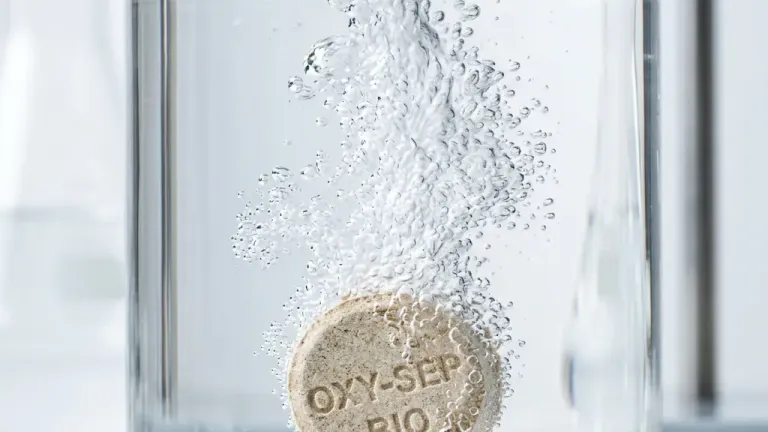
Septic tank treatment tablets solve both the dilution and delivery problems through physics and chemistry.
- Targeted Delivery: A dense tablet is designed to sink rapidly. Instead of floating in the scum layer or diluting in the water column, it drops directly to the bottom of the tank, resting directly on the problem area: the sludge layer.
- Effervescent Action: The best septic tank tablets are effervescent. As they dissolve slowly at the bottom of the tank, they release a powerful stream of oxygen micro-bubbles. This creates an immediate localized zone of high oxygen concentration right where the sludge is thickest.
- Aerobic Stimulation: This oxygen release awakens and supercharges the naturally occurring aerobic bacteria, allowing them to rapidly digest the solid sludge from the bottom up. Learn how oxygen fuels aerobic bacteria in your tank for faster digestion. You should also read about how tablet treatments also eliminate odors as a secondary benefit. This makes incorporating tablets into your maintenance routine the most effective way to protect your system.