
Snow Melting Over Septic Tank? What It Means & When to Act
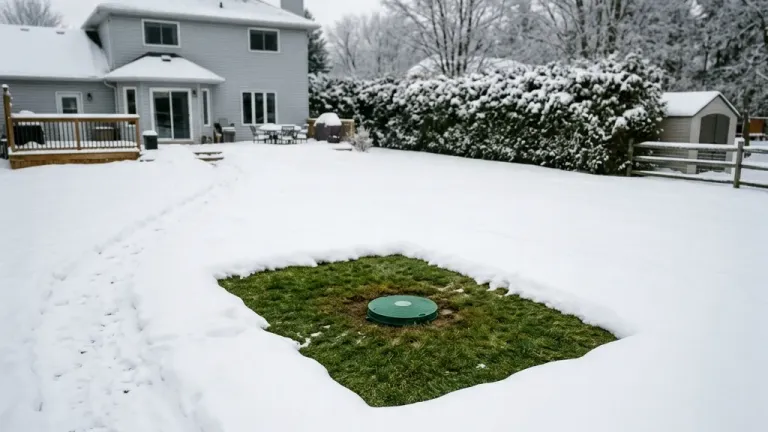
Why Is the Snow Melting Exactly Over My Septic Tank?
You step outside in January and notice it immediately: a perfectly shaped, bare patch of ground directly above where your septic tank is buried, while everything around it is blanketed in snow. The pattern is too precise to be a coincidence.
It isn’t.
Your septic tank is warm. The biological decomposition happening inside the tank generates heat as a natural byproduct of bacterial activity. That thermal energy radiates upward through the soil and melts the snow above it. This process happens every winter in every functioning septic system — and for most homeowners, it is completely normal.
The question is: is your snow melt a sign of a healthy tank, or an early warning of system failure?
The Normal Scenario: Biological Heat Generation
A healthy septic tank maintains an internal temperature of approximately 60°F to 70°F (15°C to 21°C) year-round. This warmth comes from two sources:
-
Incoming wastewater: Shower water, dishwasher discharge, and laundry water enter the tank at temperatures that significantly exceed the surrounding frozen soil.
-
Microbial activity: The anaerobic bacteria digesting solid waste in your tank generate heat as a metabolic byproduct — similar to how a compost pile stays warm in winter.
The result is a zone of warmth around the tank that conducts upward through the soil and melts snow in a predictable oval or rectangular pattern that mirrors the shape and location of the buried tank.
If the snow melt is confined to the area directly above the tank and the yard is otherwise normal, you are almost certainly witnessing normal biological heat generation. No action is required.
The Warning Scenario 1: Melt Extends Over the Drain Field
This is the scenario that requires immediate attention.
If the snow is also melting in a pattern that follows the lines of your drain field — the area beyond the septic tank where the liquid effluent is distributed — you have a problem.
What It Means
When the drain field is also warm enough to melt snow, it indicates that:
- The drain field is receiving warmer-than-normal effluent — which happens when liquid waste is passing through the tank without being properly processed. This can occur when the bacterial population is depleted or the tank is hydraulically overloaded.
- Hot wastewater is flowing directly to the field without adequate treatment, suggesting the system is failing to separate and process waste before discharge.
- In the most serious cases, warm sewage effluent is pooling near the surface of the drain field — a sign of system failure that requires immediate professional evaluation.
Action Steps
If snow is melting over the drain field:
- Reduce household water usage immediately.
- Do not add any additional chemical drain cleaners or antibacterial products.
- Inspect the yard surface for soft, spongy, or wet soil over the drain field lines.
- Check for outdoor sewage odors.
- Call a licensed septic contractor for an emergency inspection.
The Warning Scenario 2: Snow Melt With Sewage Odors
Snow melting over the tank is normal. Snow melting over the tank accompanied by a rotten egg or sewage smell outdoors is not.
Hydrogen sulfide gas (the source of the “rotten egg” odor) is produced when the septic tank’s bacterial ecosystem is disrupted — typically by excessive use of antibacterial products, chemical drain cleaners, or bleach. When the tank’s beneficial bacteria die, the decomposition process shifts from the controlled biological digestion to uncontrolled anaerobic decomposition, producing high concentrations of H2S gas.
Hydrogen sulfide gas can escape through frozen soil cracks in winter more easily than in warmer months. A rotten egg smell outdoors near your tank in January or February should trigger an immediate tank inspection — not a wait-and-see approach.
— Residential Environmental Health Advisory
If you smell sewage or sulfur outdoors near your tank, read our complete guide on winter septic system performance to understand what the cold is doing to your bacterial activity — and how to address it before spring thaw reveals more serious problems.
The Warning Scenario 3: Tank Lid is Exposed or Frost-Free
If the snow melt is so aggressive that it has melted all the way down to expose the buried tank lid while surrounding soil is still frozen solid, this suggests an unusually high level of heat generation — which may indicate that the tank is receiving a very high volume of hot water, or that the lid or insulation above the tank is compromised.
Exposed tank lids in winter create a risk of accidental damage from lawn equipment and a potential safety hazard. Contact your septic service provider to inspect the burial depth and insulation condition.
Cold Weather and Bacterial Slowdown: What Else to Watch For
Beyond snow melt patterns, winter introduces a different septic challenge: cold temperatures reduce bacterial activity. When soil temperatures drop below 40°F (4°C) near the drain field, the biological treatment happening in the soil slows significantly.
Signs that cold is affecting your system’s bacterial performance:
- Drains become noticeably slower in December and January.
- Slight odors from drains indoors that were not present in summer.
- The system seems to recover as temperatures rise in February or March.
To maintain bacterial activity through winter, adding a biological supplement in late autumn — before temperatures drop — can make a significant difference in system performance throughout the coldest months.
Quick Reference: Snow Melt Scenarios
↔ Scroll horizontally to see full comparison table
| What You See | Likely Cause | Action Needed |
|---|---|---|
| Snow melts only over the tank footprint | Normal biological heat | None — monitor only |
| Snow melts over tank AND drain field lines | Effluent flowing untreated to field | Reduce water use; call contractor |
| Snow melt with rotten egg odors | H2S from bacterial disruption | Immediate inspection |
| Tank lid fully exposed, surrounding soil frozen | High heat output or insulation issue | Contact septic service |
| No snow melt at all over tank in extreme cold | Low bacterial activity or frozen inlet | Winter biological supplement |
Conclusion
Snow melting over your septic tank is, in most cases, a reassuring sign that your system’s biology is working exactly as it should. The problem is when that melt pattern extends beyond the tank or is accompanied by odors — those are the signals that require urgent attention before a winter system failure forces an emergency response in freezing temperatures.
Read: Complete Winter Septic Maintenance Guide
Cold weather is the biggest annual stress test for any septic system. Learn how to protect your bacterial ecosystem, prevent frozen inlets, and read the snow melt patterns that tell you how your system is really performing this winter.
Read the Full Guide