
Winter Septic System Prep & Performance Guide for Homes
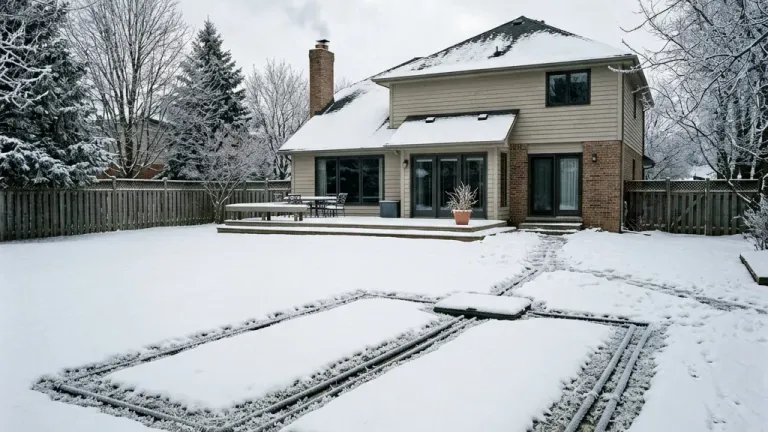
The Cold Weather Variables Most Homeowners Miss
For the approximately 21 million American households on private septic systems in northern climate zones, winter introduces a distinct set of stressors that don’t exist in warmer regions. These are not catastrophic failures — they are gradual, cumulative performance degradations that, left unaddressed over multiple winters, significantly shorten system lifespan.
The two primary mechanisms are reduced biological activity from lower temperatures and physical risk from freezing in distribution lines, tank risers, and exposed plumbing connections. If you observe bare patches in your winter lawn, read our guide on what snow melting over your septic tank indicates.
How Cold Temperatures Suppress Bacterial Activity
The biological breakdown of organic waste in your septic tank is performed by bacteria whose metabolic rate is directly tied to temperature. You can read more about how temperature affects bacterial metabolism to understand the science. This is not a design flaw — it is basic microbiology. The relationship follows what engineers call the Arrhenius equation: for every 10°C (18°F) drop in temperature, bacterial metabolic rates roughly halve.
Practical implications for a residential septic tank:
- At 68°F (20°C) — optimal summer conditions — bacterial populations are metabolically active and digesting organic waste efficiently.
- At 50°F (10°C) — early winter underground conditions — the same bacterial population is operating at approximately 50% of its summer efficiency.
- At 40°F (4°C) — deep winter conditions in northern states — biological breakdown slows to roughly 25–30% of warm-season capacity.
This means that the same household waste load that your system handles comfortably in July is being processed much less efficiently in January. Sludge accumulates faster. Scum layers thicken more quickly. The effluent exiting the tank carries a higher suspended solids load — increasing the rate at which drain field soil pores become clogged.
The Physical Freezing Risk
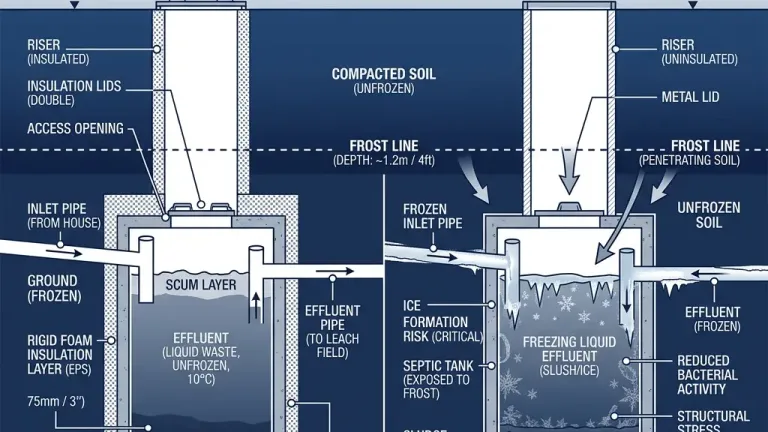
Beyond biological slowdown, cold weather introduces direct physical risk to specific system components:
Inlet and outlet pipes: The sections of pipe that transition between the heated house and the underground tank are most vulnerable. If these pipes have any low-slope sections where effluent can pond and sit motionless during periods of low household water use, that standing liquid can freeze solid, completely blocking flow.
Tank risers: Access risers that extend from the tank to ground surface are particularly exposed. Water or condensation that accumulates in risers and freezes can crack plastic risers and displace concrete ones.
Distribution pipes: In gravity-fed drain field systems, distribution pipes running at very shallow depth (less than 12–18 inches) are at risk of freezing if the soil above them loses all insulating vegetation cover (from lawn damage or excavation) and is exposed to sustained sub-zero temperatures.
Pump chambers: In systems with effluent pumps, the pump vault and float controls can freeze if the chamber lid is not insulated.
High-Risk Conditions to Watch For
Several specific conditions significantly increase winter freeze risk for residential systems:
- Compacted snow or ice over the septic area — Snow is an excellent insulator. Compacted or removed snow (from plowing or foot traffic) exposes soil to direct cold air, accelerating frost penetration.
- Reduced household water use — Warmer effluent flowing regularly through the system helps maintain temperature. Vacation properties or homes with reduced winter occupancy lose this thermal benefit and are at much higher freeze risk.
- New system installations — First-winter installations lack the established vegetation cover (grass root mass) that provides significant soil insulation.
- Shallow system components — Older installations in northern states sometimes have components at depths that were adequate historically but are increasingly marginal given more severe winters.
Seasonal Preparation Checklist
Before winter:
- Pump the tank if sludge depth is at or above 25% of tank capacity — winter is the worst time to schedule emergency pumping. Learn why winter pumping carries an emergency surcharge before deferring this maintenance.
- Ensure adequate grass cover over the drain field to provide soil insulation; do not mow short before winter.
- Insulate exposed risers with foam board or commercial riser insulation covers.
- Reduce or eliminate garbage disposal use through winter to lower organic loading when biological activity is suppressed.
During winter:
- Maintain regular household water use through vacation periods — set fixtures to drip if the home is unoccupied.
- Avoid parking or driving over the drain field and septic tank area, which compacts soil and reduces insulating air pockets.
- Do not place snow removal piles over septic system components.
After winter:
- First spring inspection should assess whether any pipes or risers show frost damage.
- Consider biological recharging with aerobic bacterial inoculants in early spring, when warming temperatures begin restoring metabolic activity.
The Biological Maintenance Angle
One underappreciated strategy for northern homeowners is pre-winter biological conditioning — introducing a concentrated aerobic bacterial population and oxygen-releasing treatment in late fall, before temperatures drop. Research treatments that work effectively in near-freezing water for this step. While bacterial activity will slow through winter, establishing a robust, well-fed population in October means there is more biological capacity remaining to sustain even at reduced metabolic rates.
Systems that maintain better biological health through winter recover faster in spring and are less likely to have accumulated sufficient sludge or scum to require emergency pumping before the standard inspection cycle.
This is particularly relevant for households with higher-than-average organic loading — large families, frequent entertaining, or heavy use of garbage disposals — where winter biological slowdown compounds an already challenging organic balance. This makes adjusting your maintenance for cold climates absolutely critical.