
Septic Pumping Costs: Exposing the True Prices for 2026
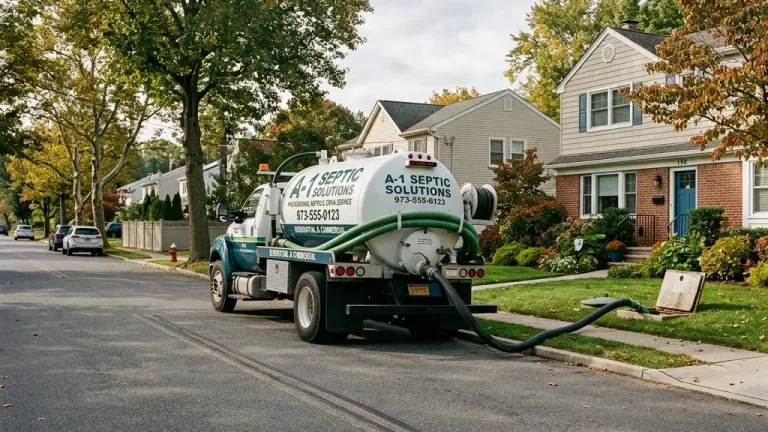
What You’re Actually Paying For When You Call the Pump Truck
The standard price homeowners hear quoted for septic pumping — typically $300 to $500 — represents only the base extraction fee. That number accounts for the truck’s arrival, the physical suction of tank contents, and transport to a licensed disposal facility. What it frequently does not include:
- Access and excavation fees — If your tank lid is buried (common in pre-1990s installations), uncovering it can add $75–$200 per service.
- Inspection add-ons — Many technicians will offer or require a camera inspection of the inlet and outlet baffles. These range from $150 to $400 depending on the provider.
- Emergency or after-hours surcharges — Septic emergencies don’t follow business hours. Weekend or holiday call-outs typically carry 50–100% surcharges over base rates. Understanding why winter emergencies cost more is critical for household budgeting.
- Disposal fees — In states with strict wastewater regulations, tipping fees at licensed septage facilities have increased sharply, and many operators pass these costs directly to the homeowner.
A realistic, all-in cost for a single pumping service in 2026 — including standard access and a basic inspection — ranges from $450 to $950 in most U.S. suburban markets. In high-cost-of-living regions (New England, the Pacific Northwest, metro New York and New Jersey), all-in costs regularly exceed $1,100.
Calculate Your 10-Year Septic Costs
Compare the long-term cost of reactive pumping versus proactive biological maintenance for your specific household.
Read the Full GuideThe Frequency Problem: Why Every 3–5 Years Doesn’t Work for Most Homes
The “every 3–5 years” guidance that most homeowners receive reflects the pumping interval appropriate for a correctly functioning system with low-to-moderate organic loading. It assumes a well-maintained tank with healthy biological activity, average household size, and moderate water use.
In practice, the factors that extend pumping frequency beyond the textbook model include:
- Household size vs. tank capacity: A 1,000-gallon tank serving a family of five accumulates solids at a significantly faster rate than the same tank serving two people.
- Garbage disposal use: Grinding organic food waste and sending it into the septic system dramatically accelerates sludge accumulation — some wastewater engineers advise against using garbage disposals in homes on private septic systems entirely. Learn how FOG increases pumping frequency when fats, oils, and grease are introduced.
- High water-use appliances: Multiple daily showers, large washing machine loads, and older toilets (3.5+ gallons per flush) hydraulically overload smaller tank systems faster than design specifications account for.
- Absence of biological treatment: Tanks that rely on naturally occurring anaerobic bacteria — without any supplemental biological support — accumulate sludge faster than tanks that maintain an active aerobic bacterial ecosystem.
For the realistic average American household on a private septic system, the effective pumping interval under current conditions is 18 to 30 months, not 3–5 years.
The Hidden Cost: What Happens When You Wait Too Long
The financial exposure that most homeowners underestimate is not the cost of pumping — it’s the cost of what happens when pumping is deferred too long, or when the system’s biological balance is chronically neglected. For a deep dive into unbudgeted home expenses, read our report on hidden septic infrastructure costs.
Drain field failure is the catastrophic endpoint of long-term septic system neglect. When undigested solids from the tank migrate into the drain field’s gravel and soil layers, they create what engineers call a biomat — a dense, impermeable layer of anaerobic bacterial film and organic debris that prevents effluent from percolating into the soil. Learn the real cost of drain field failure before ignoring early warning signs.
Once a biomat has formed, the drain field itself begins to fail. Liquid effluent backs up into the tank, into the home’s plumbing, and eventually surfaces in the yard. At this stage, the repair options are:
↔ Scroll horizontally to see full comparison table
| Intervention | Estimated Cost Range |
|---|---|
| Biomat remediation (biological) | $300–$800 |
| Drain field aeration (mechanical) | $1,500–$4,000 |
| Partial drain field replacement | $5,000–$10,000 |
| Full drain field replacement | $10,000–$25,000 |
| Full system replacement (tank + field) | $20,000–$50,000+ |
These numbers reflect 2026 contractor pricing across U.S. suburban and semi-rural markets, where labor costs have increased substantially since 2022 and excavation equipment rental costs have followed construction inflation trends.
The 10-Year Financial Model: Reactive vs. Proactive
For a representative suburban household on a 1,000-gallon tank, consider two scenarios over a 10-year period:
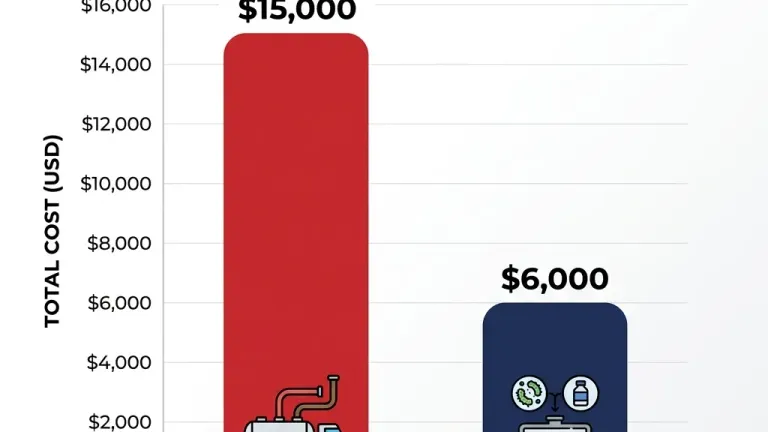
Scenario A — Purely Reactive: Pump when symptoms appear (approximately every 18–24 months), no biological maintenance between services. Over 10 years: 5–6 pumpings at $500–$800 each = $2,500–$4,800. Does not include the statistically significant probability of partial drain field remediation or replacement during this window.
Scenario B — Proactive Biological Maintenance: Pump every 36–48 months (reduced frequency through improved biological breakdown), combined with monthly biological treatment. Over 10 years: 2–3 pumpings at $500–$800 each + monthly biological treatment at approximately $10–$20/month = $1,500–$3,600 total. Significantly lower probability of drain field intervention.
The financial advantage of proactive biological maintenance compounds over time — not only through reduced pumping frequency, but through the dramatically lower risk of the catastrophic drain field failure that reactive-only homeowners face. Implementing proactive maintenance to reduce pumping frequency is the best investment you can make in your property.
What Certified Wastewater Specialists Recommend
Independent wastewater management specialists increasingly advise a two-part maintenance approach for residential systems:
- Scheduled biological maintenance — Monthly introduction of aerobic bacteria and oxygen-releasing compounds to sustain active biological breakdown between mechanical pumpings.
- Condition-based mechanical pumping — Rather than calendar-based scheduling, pumping triggered by actual sludge depth measurements (typically assessed by a licensed inspector every 2–3 years). Knowing what an inspection report reveals about costs can save you thousands.
This approach reflects how municipal wastewater facilities are managed: continuous biological treatment with mechanical intervention only when biological processes alone are insufficient. Translating that methodology to residential scale is the central argument for biological treatment additives as a legitimate, cost-justified maintenance tool — not as a replacement for pumping, but as a mechanism to extend intervals and protect drain field longevity. Review the biological alternatives that extend pump intervals to get started, or read our special report on why mechanical pumping isn’t enough for a deep dive into oxygen-based treatments.
Key Financial Takeaways for Homeowners
- All-in pumping costs in 2026 range from $450 to $950+ in most U.S. markets — not the advertised base rate.
- Most suburban households need pumping every 18–30 months under real-world conditions, not every 3–5 years.
- Drain field failure — the endpoint of neglect — costs $10,000 to $50,000+ to remediate or replace.
- Proactive biological maintenance, integrated with condition-based mechanical pumping, is the financially rational long-term approach.
Free Homeowner Tools
- Calculate Your Pumping Schedule — Enter your tank size and household details to get a personalized maintenance interval.
- Annual Cost Estimator — Project your 1-year and 5-year out-of-pocket costs based on your system’s age and region.