
Best Septic-Safe Toilet Paper: Expert Guide
Why Toilet Paper Choice Actually Matters for Septic Systems
Homeowners on municipal sewer systems rarely think about which toilet paper they buy. For the 21 million U.S. households on private septic systems, it’s a more consequential decision than most realize.
The reason comes down to what happens inside the septic tank. Toilet paper that doesn’t dissolve rapidly doesn’t simply “sit” in the tank harmlessly — it accumulates in the scum layer, partially digests and forms fibrous mats that can clog inlet distribution tees, and migrates toward the drain field where it contributes to biomat formation.
Over months and years, the cumulative effect of slow-dissolving paper measurably accelerates sludge accumulation and shortens the effective interval between pumpings. It also increases the probability of inlet and outlet baffle clogging — a repair that typically costs $150–$600 per service call.
What Makes Toilet Paper “Septic Safe”?
The term “septic safe” on toilet paper packaging is largely unregulated — manufacturers self-certify. However, the underlying characteristics that make toilet paper genuinely compatible with septic systems are measurable:
1. Rapid wet-strength breakdown Standard toilet paper relies on wet-strength resins (typically polyamide-epichlorohydrin compounds) that allow the paper to hold together under normal use. Septic-compatible papers use lower concentrations of these resins, allowing fibers to separate quickly when flushed.
2. High fiber porosity 1-ply papers dissolve significantly faster than 2- or 3-ply equivalents. The adhesion layer between plies adds breakdown time. Recycled-fiber papers, which have already been mechanically broken down once, tend to dissolve faster than virgin-pulp alternatives.
3. Short fiber length Premium “ultra soft” toilet papers use long, tightly bonded fibers for their texture profile. These same long fibers are slower to break apart in water and more likely to form entangled mats in the tank.
The Dissolution Test: How to Evaluate Any Brand
You can conduct a basic dissolution test at home with any toilet paper brand:
- Fill a clear glass jar with tap water
- Add 4–6 sheets of toilet paper
- Seal and shake 10 times
- Observe after 30 seconds
Result interpretation:
- Fully broken into loose fibers: Good dissolution — appropriate for septic use
- Partially broken, some clumping: Marginal — acceptable for well-maintained systems, not ideal
- Intact or large clumps remain: Poor dissolution — avoid for septic system use
Which Types of Toilet Paper Perform Best?
Based on dissolution testing data and wastewater specialist recommendations:
↔ Scroll horizontally to see full comparison table
| Type | Dissolution Rate | Septic Compatibility |
|---|---|---|
| 1-ply recycled fiber | Fastest | Excellent |
| 1-ply virgin pulp | Fast | Excellent |
| 2-ply standard | Moderate | Good |
| 2-ply "septic safe" labeled | Moderate | Good |
| 3-ply standard | Slow | Marginal |
| 3-ply ultra-premium | Very slow | Not recommended |
| Flushable wipes (any brand) | Very slow / minimal | Avoid entirely |
Flushable Wipes: The Highest-Risk Category
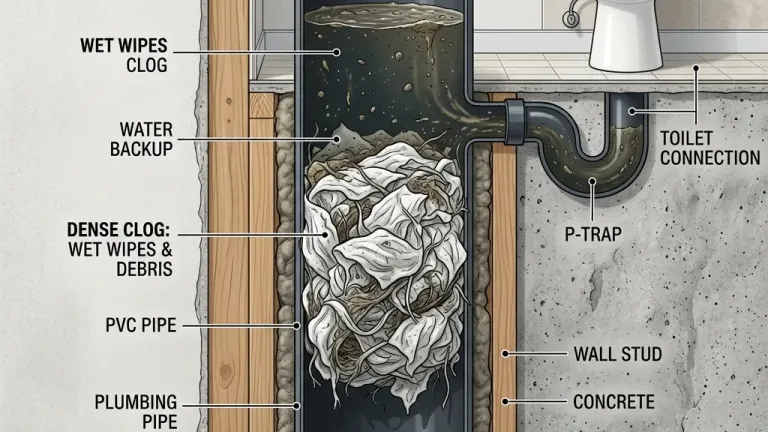
“Flushable” wipes are a regulated but misleading category. They are designed to survive the flushing process — which means they are, by design, resistant to the rapid breakdown that septic systems require.
Multiple wastewater industry studies have documented “flushable” wipes as intact material in septic systems months to years after flushing. They tangle around inlet baffles, accumulate in distribution lines, and resist biological breakdown almost entirely.
If your household uses wet wipes, they should be disposed of in a waste bin — not flushed — regardless of what the packaging indicates.
“The term ‘flushable’ as applied to personal care wipes describes the ability to travel through a toilet trap, not suitability for biological treatment systems. All tested wipe products in our study retained greater than 60% structural integrity after 30 days of immersion in simulated septic tank conditions.”
What Else Should Never Be Flushed Into a Septic System?
Toilet paper choice is one factor. The broader category of non-organic materials that shouldn’t enter a septic system includes:
Never flush:
- Paper towels or napkins (wet-strength resins; designed not to dissolve)
- Cotton balls and swabs (fibers are non-biodegradable)
- Feminine hygiene products (non-soluble; accumulate rapidly)
- Dental floss (wraps around mechanical components and baffles)
- Prescription and over-the-counter medications (chemical impact on bacterial populations — see our article on medications and septic system biology)
- Cat litter, even “flushable” varieties (clay-based; forms dense solid mass)
- Cigarette filters (synthetic cellulose acetate; non-biodegradable)
- Condoms (latex; completely non-biodegradable)
Use with caution:
- Bleach-based cleaning tablets in toilet tanks (antimicrobial effect suppresses bacterial populations over time)
- High-concentration antibacterial soaps drained into bathroom sink lines
The Cumulative Effect on Pumping Frequency
Poor flushing habits — including the regular use of slow-dissolving toilet paper — don’t typically cause acute failures. Their effect is gradual and cumulative: slightly faster sludge accumulation per month, which over 2–3 years meaningfully reduces the interval between necessary pumpings.
A household that consistently uses 3-ply premium paper and occasionally flushes wipes may find themselves pumping every 18 months rather than every 30–36 months — an additional $400–$700 in service costs per year, every year. Combined with the increased risk of inlet and outlet baffle clogging, the actual cost of poor paper choice is meaningful over a 10-year ownership horizon.
Proper toilet paper selection is one component of a broader septic maintenance strategy. For the complete picture, see our septic system maintenance guide.
Key Takeaways
- “Septic safe” labeling is self-regulated — the dissolution test is the only reliable evaluation method.
- 1-ply recycled fiber toilet paper dissolves the fastest; 3-ply ultra-premium dissolves the slowest.
- “Flushable” wipes are not compatible with septic systems and should be disposed of in the trash.
- Poor paper choice accelerates sludge accumulation and measurably reduces pumping intervals over time.
- Paper towels, feminine hygiene products, medications, and cotton products should never be flushed.
Free Homeowner Tools
- Pumping Interval Calculator — See how current habits affect your estimated pumping schedule.