
How Often Should You Pump Your Septic Tank? A True Timeline
The Short Answer Most Homeowners Don’t Expect
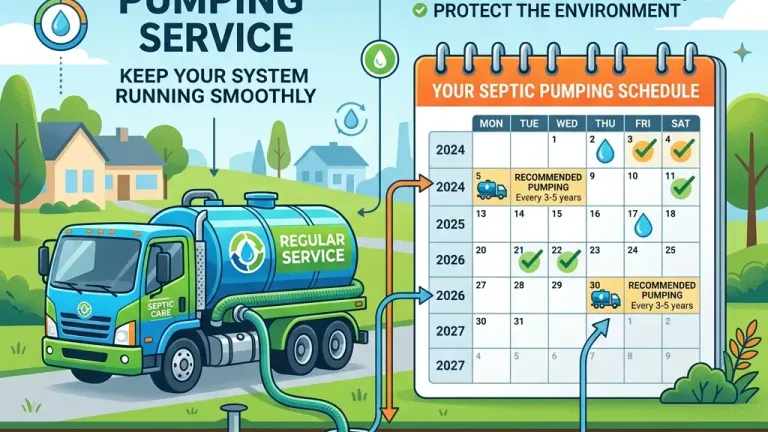
If you ask a septic pumping company how often you should service your tank, the answer is almost universally “every 3 to 5 years.” That figure comes from a 1978 EPA guidance document written for average-sized tanks serving average-sized households under average conditions.
For the majority of American homes in 2026, that number is wrong.
The correct pumping interval depends on four variables: tank capacity, household size, daily water usage, and the biological health of your system. For many suburban families, the realistic interval is closer to 18 to 30 months — and for homes on biological treatment programs, some systems extend comfortably beyond 4 years between services.
The Formula That Actually Works
The U.S. Environmental Protection Agency uses a simplified model to estimate pumping frequency. The key variables are:
- Tank size (gallons)
- Number of occupants
- Volume of scum and sludge as a percentage of total tank capacity
When combined sludge and scum layers reach approximately 25–33% of tank capacity, pumping is warranted. Below that threshold, the tank is managing normally.
Pumping Frequency by Household Size and Tank Capacity
The following table reflects realistic intervals for U.S. households under typical water use conditions, without biological additives:
↔ Scroll horizontally to see full comparison table
| Tank Size | 1–2 Occupants | 3–4 Occupants | 5–6 Occupants |
|---|---|---|---|
| 500 gal | 1.5 years | 0.8 years | 0.5 years |
| 750 gal | 2.6 years | 1.3 years | 0.9 years |
| 1,000 gal | 4.2 years | 2.1 years | 1.4 years |
| 1,250 gal | 5.9 years | 2.9 years | 1.9 years |
| 1,500 gal | 7.5 years | 3.7 years | 2.5 years |
Note: These intervals assume no garbage disposal use, moderate laundry loads, and standard water fixtures.
Factors That Accelerate Sludge Accumulation
Several household behaviors push pumping intervals toward the shorter end — or beyond the table above:
Garbage Disposal Use
Running a garbage disposal introduces ground organic solids directly into the tank. This is one of the most significant accelerants of sludge buildup. Wastewater engineers frequently advise against disposal use in homes on private septic systems. Learn more about how food waste affects your system.
High Water Volume Days
Laundry days, guests, or any event that sends large volumes of water through the system in a compressed timeframe can hydraulically shock the tank — flushing partially digested solids toward the drain field before they’ve been properly broken down.
Medications and Antibacterial Products
Frequent use of antibiotics, certain heart medications, and antibacterial soaps can suppress the bacterial populations responsible for breaking down solids. A biologically weakened tank accumulates sludge faster than a healthy one. For a full overview, read our article on how medications affect septic system bacteria.
Cold Weather Months
Bacterial activity in a septic tank slows significantly in cold climates. In northern U.S. states, winter months can reduce biological breakdown efficiency by 30–50%, accelerating solid accumulation during those periods. Winter septic system performance covers this in detail.
What a Sludge Judge Tells You That a Calendar Can’t
The most accurate method for determining pump timing is direct measurement of sludge depth using a sludge judge — a clear acrylic tube that a technician lowers into the tank to capture a column of material for visual inspection.
If you hire a septic inspector on a 2–3 year basis, they can take this measurement and tell you definitively whether pumping is needed. This approach — called condition-based maintenance — is more precise than any calendar schedule and prevents both unnecessary pumpings and delayed ones.
“Calendar-based pumping schedules are a convenience metric, not an engineering recommendation. Sludge depth measurement is the only reliable indicator of pumping necessity for residential systems. Homeowners who transition to condition-based inspection schedules consistently report both cost savings and improved system longevity.”
The Role of Biological Health in Extending Intervals
A tank with a healthy, active aerobic bacterial population breaks down organic solids more efficiently than one relying on naturally occurring anaerobic bacteria alone. The practical effect: biologically healthy tanks accumulate sludge more slowly, extending the interval between mechanical services.
Homeowners who implement monthly biological oxygen-release treatments frequently extend their pumping intervals by 12 to 24 months compared to untreated tanks of equivalent size and load. This is not a marketing claim — it reflects the documented difference in breakdown efficiency between aerobic and anaerobic bacterial processes. For more detail, see our comparison of aerobic versus anaerobic bacteria in septic systems.
How to Read Your Inspection Report to Track Sludge
If you’ve had a recent septic inspection, the report should include a sludge depth measurement and a calculated sludge volume percentage. If it doesn’t, ask your inspector for this data — it should be standard. Our guide to reading a septic inspection report walks through each section line by line.
Key Takeaways
- The “3 to 5 year” pumping rule applies only to specific tank sizes and household loads — most families need service more frequently.
- A household of four with a 1,000-gallon tank should plan for pumping approximately every 2 years under average conditions.
- Garbage disposal use, high water volume, and medication exposure all reduce the effective interval.
- Sludge depth measurement is the only reliable indicator — not the calendar.
- Biologically active tanks accumulate sludge more slowly, extending intervals between mechanical services.
Free Homeowner Tools
- Pumping Interval Calculator — Enter your tank size, household size, and usage habits to get a personalized estimate.