
Do Water Softeners Damage Septic Systems? The Hidden Risks
The Historical Debate (and Where the Science Has Landed)
For decades, the question of whether water softeners are compatible with septic systems generated significant disagreement in the wastewater management community. Early position statements from some state environmental agencies recommended against water softener use in homes on private septic — based on concerns about salt loading, bacterial suppression, and hydraulic overload from regeneration cycles.
More recent research has refined this position considerably. The current scientific consensus, reflected in updated guidance from major wastewater engineering bodies, is more nuanced: the impact of a water softener on a septic system depends significantly on system design, soil type, and how the softener is configured. A blanket prohibition is not scientifically supported — but neither is unconditional approval.
What a Water Softener Actually Discharges
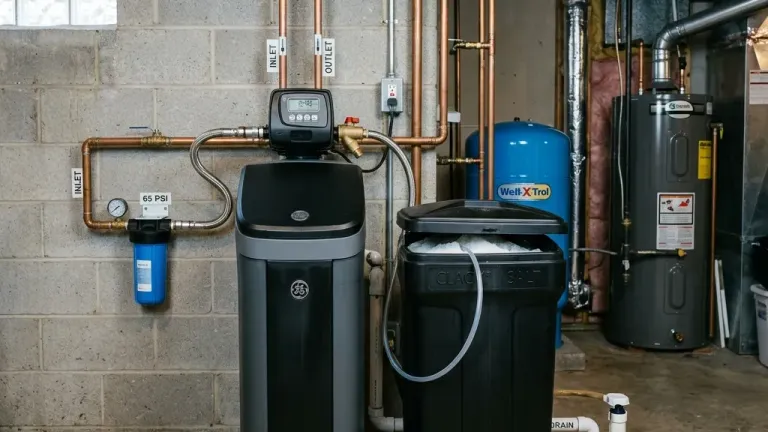
An ion-exchange water softener works by passing hard water through a resin bed that captures calcium and magnesium ions, replacing them with sodium or potassium ions. Periodically, the resin must be regenerated by flushing it with a salt brine solution, which carries the captured calcium and magnesium out of the unit as a concentrated waste stream.
This regeneration discharge contains:
- High concentrations of sodium or potassium chloride (the salt used in the brine)
- Calcium and magnesium chloride (the captured hardness minerals)
- Large volumes of water — a single regeneration cycle can discharge 40 to 150 gallons of brine water, depending on system size and efficiency
It is this discharge — specifically its salt content and hydraulic volume — that raises concerns for septic system compatibility.
Concern 1: Bacterial Suppression
The concern that high salt concentrations kill beneficial septic bacteria is frequently cited — but somewhat overstated by the older literature. It is worth reading about bacterial resilience in salt water to understand this nuance.
Laboratory studies that exposed septic tank bacterial populations to brine concentrations equivalent to softener discharge found minimal acute bacterial mortality at typical residential discharge volumes, when the brine is diluted by normal household wastewater flow within the tank. The septic tank’s large liquid volume means that even a 100-gallon regeneration brine discharge is substantially diluted before it contacts the bacterial population. For a complete analysis of salt brine threshold levels, see our guide on whether water softeners are bad for septic systems.
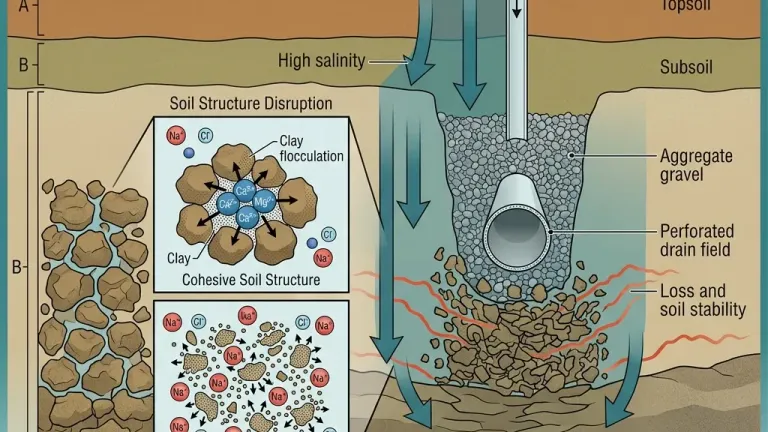
The more relevant bacterial concern is indirect: sodium-rich effluent changes the cation chemistry of the drain field soil, which affects soil structure — and it is the soil structure change, not direct bacterial toxicity, that creates the more significant long-term risk.
Concern 2: Soil Structure Degradation (The More Serious Risk)
This is where the research is more definitive, and where homeowners on certain soil types need to pay close attention.
How soil structure works in a drain field: Healthy drain field soil maintains its permeability through aggregated soil particles — clusters of clay, silt, and organic matter held together by calcium and magnesium ions (the same minerals removed by water softening). These aggregates create macro-pores through which effluent percolates.
What sodium does to soil structure: When sodium ions replace calcium and magnesium at the soil’s cation exchange sites (a process called sodium adsorption), soil aggregates lose cohesion and disperse. The result is a compacted, poorly draining soil layer — exactly the condition that prevents drain field percolation. This effect is well-documented in agricultural soil science and applies equally to residential drain field contexts. This is why testing soil for sodium-induced clay expansion is critical.
The risk is most significant in clay-dominant soils (common in the mid-Atlantic, Southeast, and Pacific Northwest) and least significant in sandy or gravelly soils with high natural permeability and low cation exchange capacity. You can learn more about how sodium damages soil percolation if you live in these areas.
Concern 3: Hydraulic Overload
A water softener that regenerates nightly can add 40–150 gallons of additional wastewater per cycle to the septic system. For households on smaller tanks or systems already near hydraulic capacity, this additional load can accelerate saturation of the drain field — independent of any salt chemistry effect.
Modern demand-initiated softeners — which regenerate only when the resin bed is actually exhausted rather than on a timer — produce significantly less discharge volume (typically 30–50% less per month) and are the recommended configuration for households on private septic systems.
Practical Assessment: Should You Use a Water Softener?
The answer depends on site-specific factors:
↔ Scroll horizontally to see full comparison table
| Factor | Lower Risk | Higher Risk |
|---|---|---|
| Soil type | Sandy, gravelly | Clay-dominant |
| Tank size | 1,000+ gallons | Under 750 gallons |
| System age | New, healthy | Aging or marginal |
| Softener type | Demand-initiated | Timer-based |
| Household water use | Average | High (large family) |
Homeowners with clay soils, older systems, or systems already showing drain field stress should consult a certified septic inspector before installing or continuing water softener use. Those with sandy soils, appropriately sized tanks, and demand-initiated softeners face substantially lower risk.
If a water softener is in use, integrating a monthly aerobic biological treatment can help partially offset sodium’s dispersive effect on the soil-bacteria interface — though it does not change the underlying soil chemistry. It is important to look for biological treatments that survive high salinity and focus on adjusting your maintenance for salt-heavy environments.